A Rainbow Is an Angle, Not a Place in the Sky
A rainbow is an angle, not a place in the sky: follow sunlight through raindrops to understand why its colours shift as you move.
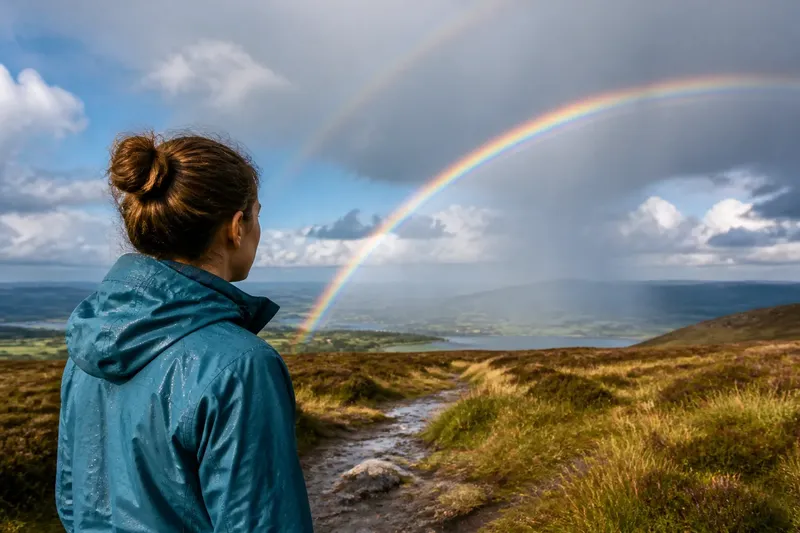
A rainbow is an angle, not a place in the sky: its position depends on where you stand, where the Sun is and which raindrops send light towards your eyes. That is why two people looking at the same shower can see bows in slightly different directions, or watch the colours shift as they walk.
Where does a rainbow appear?
Look away from the Sun, towards rain or spray, and a rainbow may form around the point directly opposite the Sun. That point is called the antisolar point. The bow sits at a particular angle from it, so your line of sight matters as much as the weather does.
The familiar arc is part of a much larger circle centred on that opposite point. From the ground, the horizon usually hides the lower part, leaving a curved section above it. From a high viewpoint, or above a cloud, a person may see more of the circle because less of it is blocked.
This geometry gives a useful field note: turn your back towards the Sun, then look into the rain in front of you. The Sun needs to be low enough for the bow to clear the horizon. A shower without sunlight cannot produce the familiar sunlit rainbow, and sunlight with no droplets to meet cannot produce it either.
What does a raindrop do to sunlight?
White sunlight contains a mixture of colours. When it enters a water droplet, it bends; some light reflects from the inside of the droplet, then bends again as it leaves. The amount of bending depends on colour, so red and violet emerge along slightly different directions.
The droplet is not a tiny screen that paints a rainbow onto the clouds. It sends particular colours towards an observer at particular angles. For the primary bow, red light reaches the eye from droplets near one angular distance from the antisolar point, while violet comes from droplets at a slightly smaller one.
These paths explain the colour order in the primary rainbow: red is on its outside edge and violet on its inside edge, with the other colours between. A secondary rainbow, when visible beyond the primary bow, has the reverse order: violet on its outside edge and red on its inside. It is not necessary to imagine a separate strip of painted sky for each colour. The eye receives each colour from a different set of droplets along the line of sight.
Why can’t you walk to the rainbow?
A distant hill has a location you can approach. A rainbow does not have one equivalent location, because the droplets contributing to it are selected by your viewing angle. Move, and the lines from your eyes change; different droplets now send the right light towards you.
Say you stand on a wet path with the Sun behind your left shoulder and a patch of spray ahead. You see a bright bow. If you take a few steps sideways, the spray and sunlight remain in the scene, but the angle from your eyes to the droplets changes; the bow’s apparent position shifts, and some colours may dim as the droplets no longer line up for them.
A companion standing beside you has a slightly different viewpoint and therefore a different set of droplets in the right directions. The two bows may overlap so closely that they look like one. Still, the droplets sending light to your companion’s eyes are not exactly the same ones sending light to yours.
That does not make the rainbow imaginary. Its colours are real light, and droplets are real objects. What depends on the observer is the particular arrangement that makes those colours appear as a bow in a particular part of the view.
Why is the bow circular?
For each colour, the useful droplets lie around a cone whose point is your eye and whose axis runs through the antisolar point. Where that cone meets the rain, its outline appears as a circle in your view. The ground, buildings and uneven distribution of droplets interrupt the outline, so the scene usually reveals an arc rather than a complete ring.
The circle’s apparent size is set by the angle, not by how far away the rain looks. A nearby shower does not necessarily make a larger rainbow, and a distant rain curtain does not necessarily make a smaller one. Distance affects which droplets are available to see; it does not turn the bow into an object with a fixed diameter.
Cloud gaps and patches of sunshine can make the arc seem to start or stop abruptly. Often, this is simply where illumination or droplets are missing, or where an obstacle blocks the view. The geometric circle can extend beyond the bright section that the eye can pick out.
What changes when you move or the light changes?
Watch the antisolar point, not a presumed “end” of the rainbow. As you turn, the point opposite the Sun turns with you, and the bow’s position follows that geometry. If the Sun moves lower or higher, the relationship changes too; the arc’s visible height can alter even if the shower remains in the same general direction.
Other changes are less dramatic. A thick cloud may dim the sunlight, while a denser patch of rain may make the bow brighter. The background matters as well: a dark cloud can make colours easier to distinguish than a bright, washed-out patch of sky. Brightness and visibility can change without the rainbow becoming a physical object that has moved across the landscape.
It is not worth chasing a visible endpoint to find where the bow touches the ground. That endpoint is an effect of your view and the scene’s obstructions, not a marker of treasure, a pot or a place where the colours land.
Which questions help make sense of a rainbow?
Can two people see the same rainbow?
They can see bows that appear to occupy the same part of the sky, especially when they stand close together. Their viewing angles still differ, so the droplets sending light to each person are not precisely the same.
Why does a rainbow follow me?
It is not following you as an object would. When you move, the angle from your eye to the droplets changes, and another set of droplets can send the relevant colours towards you in the bow’s apparent position.
Can I see a rainbow at night?
A bright Moon can provide light for a faint lunar rainbow if rain or spray lies in the right direction. The same observer-dependent geometry applies, though the colours may look muted to human eyes in dim light.
Why is the sky inside the bow sometimes brighter?
Light paths through droplets concentrate some scattered light towards the observer at angles inside the primary bow. The contrast can make the area inside look brighter than the sky just outside, though clouds and changing illumination affect how clearly the difference shows.
What can you check during the next shower?
- Check the Sun’s direction: if sunlight is behind you and rain or spray lies ahead, look for a bow; if not, turn to face away from the Sun or wait for a change in the light and rain.
- Check the opposite point: if you can identify the antisolar point opposite the Sun, use it as the centre for the bow’s apparent circle; if it is hard to pick out, extend an imaginary line from the Sun through your head and look along its continuation.
- Check which bow you are observing: if it is the primary rainbow, expect red outside and violet inside; if a fainter secondary bow appears beyond it, expect the colour order to be reversed.
- Check what happens when you shift position: if the bow’s apparent place changes as you move, take that as a sign that viewing angle matters; if it remains hard to see, pause and check whether clouds or obstacles are blocking the light or rain.
- Check what interrupts the circle: if a roofline, horizon or gap in the rain hides part of the arc, treat it as an obstruction rather than a physical endpoint; if no obstacle is apparent, look for uneven rain or illumination.
- Check the background and brightness: if colours stand out against a dark cloud, observe their order there; if they look washed out, shift your gaze to a darker patch of sky or wait for the light to change.
These observations make the central point easy to see: a rainbow is not waiting at a destination in the sky. It is a pattern of light selected by the angle between the Sun, droplets and observer. The next time the colours appear over a familiar roof or hillside, the scenery supplies the backdrop; your viewpoint supplies the geometry.