The First Coincidence Is Not a Pattern
A fair coin-toss test helps separate a genuine pattern from a lucky run: set a fixed question, record every result and know what the tally can tell you.
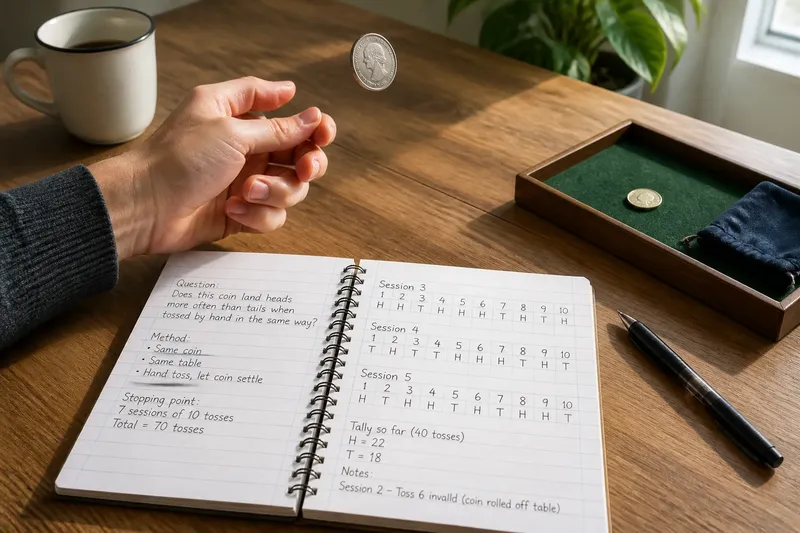
Three heads in a row can make a coin feel biased, but a short run cannot establish a dependable pattern. A fair coin-toss test begins with a specific question and a stopping point chosen before the coin leaves your hand.
Chance does not take turns neatly. A random sequence can contain clusters, streaks and lopsided patches; noticing one is a reason to investigate, not a verdict. A simple routine can keep the question steadier than your expectations, provided you do not mistake an illustrative schedule for decisive evidence.
What are you trying to find out?
Write one question that observations could answer. “Is this coin fair?” is broad: fairness might concern the chance of heads on a single toss, the tossing method, or whether the coin behaves differently with a particular technique. Narrow it to something like: “Does this coin land heads more often than tails when tossed by hand in the same way?”
Decide in advance what result would prompt a follow-up. If you only decide what matters after seeing the results, an ordinary fluctuation can be promoted into a discovery. A written question does not make the test perfect; it makes your reasoning easier to inspect.
How do you set up a fair coin-toss test?
Choose one coin, one surface and one tossing method, and keep them consistent. A wooden table and a hard floor need not behave alike, and catching a coin by hand differs from letting it settle on a surface. You do not need laboratory equipment: a notebook and a repeatable routine are enough to make the comparison clearer.
Choose a fixed number of tosses and a stopping point before you begin. Pick a total you can complete without rushing, record it in your notebook, and do not stop early because the tally looks persuasive or continue just because it looks disappointing. Without a planned number of tosses and a clear way to interpret the tally, a schedule alone cannot make the result decisive.
Record every toss in order using H and T, and note any procedural mishap. If a coin rolls off the table, mark that toss invalid and write why; do not quietly replace it with an outcome that suits the result. Keep the raw sequence, not just the final count, since the order can reveal clusters that a total hides.
How can you keep a week-long routine honest?
Say you can comfortably complete ten tosses in a sitting. You could plan seven sessions of ten tosses, for seventy tosses in all, using the same coin, table and hand-tossing method. This is an invented schedule to illustrate a consistent routine, not a statistically decisive test or a threshold for judging bias; the tally would need a more careful analysis before supporting a strong conclusion.
- Before the first session: If the question, method and total number of tosses are written down, begin; if any is missing, settle it before tossing rather than choosing it after seeing results.
- During each session: If the coin lands and can be identified clearly, record H or T in order; if it rolls away or the result is obscured, mark the toss invalid with a reason and follow the same pre-set rule for any replacement.
- When a streak appears: If a run of heads or tails tempts you to change technique, keep the original method; if the method genuinely becomes impossible to continue, note the change and treat the results as a reason to plan a separate test.
- After each session: If every valid toss has an entry and each invalid toss has a reason, close the session; if the record has a gap, resolve it from notes or mark it unresolved instead of guessing.
- At the planned stopping point: If the full pre-set run is complete, count heads and tails and compare them with your original question; if it is incomplete, report that limitation and do not present the tally as the planned result.
- When interpreting the tally: If the counts are uneven, treat that as a prompt for a better-designed follow-up, not proof of bias; if they are fairly balanced, note that the initial streak still happened but the test has not settled the question.
Imagine you suspect a coin is biased after a run of heads and plan the seven sessions described above. You write down the question, method and stopping point, then enter each toss in sequence; after the final session, you count both outcomes. If the tally is uneven, you decide to investigate further rather than declare the coin biased; if it is fairly balanced, you record that the original streak did not settle the question either. In both cases, the schedule gives you an orderly record, not a decisive verdict.
Why do short runs feel so persuasive?
Our attention is drawn to repetition. A sequence such as HHH feels more meaningful than HTHT, even though either can appear in a random run. After the fact, it is also easy to select whichever feature looks striking: a cluster of heads, a run of tails or an alternating patch.
That flexibility is the trap. If you look for enough possible patterns, one may catch your eye, but noticing it afterwards does not show that you predicted it. A pre-set question narrows the search: you know which feature you are checking before you see the sequence.
What questions come up in a coin-toss test?
Does a streak prove the coin is biased?
No. A streak is compatible with chance, especially in a short run. It can prompt a test, but it cannot by itself show that the coin behaves differently from a fair one.
Why decide the question before collecting results?
A question chosen afterwards can be tailored to whatever looks unusual. Writing it down first makes it harder to confuse a surprising observation with a prediction that came true.
Should you stop when the tally looks convincing?
No; use the stopping point you chose in advance. Stopping at a favourable moment lets chance influence when you decide the evidence is complete.
What if the result is unclear?
Say so, and keep the record intact. An inconclusive result can guide a better follow-up, perhaps one that checks whether your tossing method is consistent.
What is not worth the effort?
There is little value in tossing repeatedly until the result matches a preferred story, or adding elaborate equipment before you have a clear question. Nor does a pile of untidy observations become strong evidence merely because it is large. A simple, consistent record is more useful than a complicated setup whose procedure keeps changing.
If you investigate further, make the next test a new question rather than an improvised extension of the old one. You might ask whether a different tossing method changes the tally, but change that method deliberately and keep the other conditions steady. The first coincidence may catch your attention; a fair coin-toss test helps you decide what to do with it without pretending that a short routine has settled the matter.