Why Soap Bubbles Settle into Round Shapes
Why soap bubbles settle into round shapes: learn how surface tension favours compact films, and why gravity, pressure and the wand can alter the result.
Why soap bubbles settle into round shapes is easiest to see as a balance, not a rule that forces every bubble into a perfect sphere. Surface tension tends to shrink the film, while enclosed air, pressure, gravity and any attached boundary also shape its equilibrium.
What pulls the film into shape?
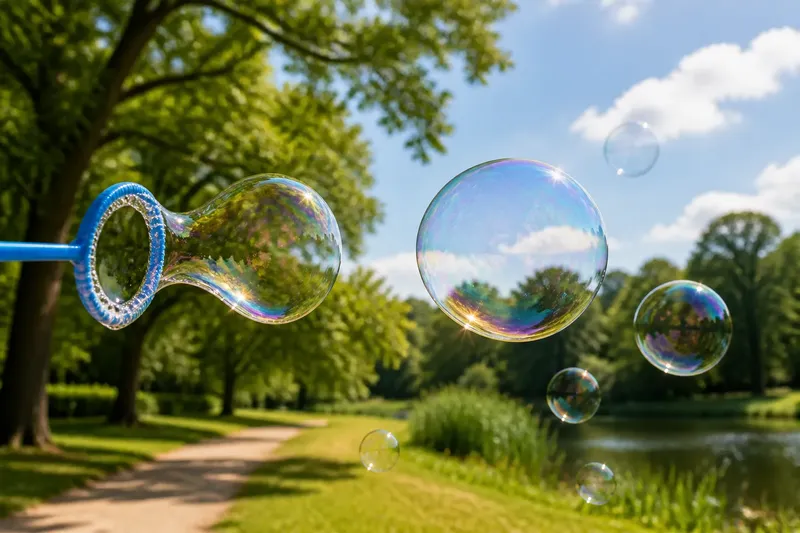
Dip a circular plastic wand into washing-up liquid and lift it slowly. A thin film stretches across the ring, shimmering with colour; move the wand gently and the film can bulge out around a pocket of air.
The liquid film has two air-facing surfaces: one on the bubble’s inside and one on its outside. Both contribute to the film’s surface energy. Attractions among the liquid molecules make the film tend to contract, while the air pocket and the film’s surroundings constrain how far it can move.
That tendency helps explain why the free part of a bubble rounds out. It does not mean the film simply minimises area without qualification: pressure differences, gravity, air movement and the condition of the liquid film all matter too.
Why does a sphere often emerge?
For a fixed enclosed volume, a sphere has less surface area than any other shape. Since more stretched film generally means more surface energy, a free bubble tends towards a compact, rounded form when other influences are modest.
The wand complicates the picture. While the film is attached to its rim, the rim fixes part of its boundary, so the bubble cannot settle as an unconstrained sphere. Once a pocket detaches, the surface can shift more freely, though it still responds to pressure, gravity and disturbances.
Think of this as a physical tendency rather than a calculation performed by the bubble. Neighbouring parts of the film pull on one another; the shape changes as those forces interact. A nearly still, intact bubble may become rounder, but it need not reach an ideal geometric form.
What happens when a bubble leaves the wand?
Say you dip a clean circular wand into bubble mixture, lift it, then move it gently until a bulge forms. In this invented situation, you pause and draw the wand away; if the narrowing film at the rim pinches free without tearing, the pocket separates. You would expect its outline to become roughly rounded as the detached film shifts, while a small tail may retract or break away.
If the film tears first, there is no separate bubble to observe. If it detaches but remains in motion, the bubble may wobble or look lopsided before settling into a steadier shape. That contrast shows why roundness is an outcome of competing conditions, not a shape imposed by the wand.
A flat soap film across a ring is different from a free bubble. The ring holds the film’s edge in place, and there is no distinct enclosed pocket. Remove or change that boundary and the film can contract or rearrange rather than behaving like a floating bubble.
Why can real bubbles look lopsided?
Gravity draws liquid downwards through the film, and a nearby surface, air current or lingering wand can distort the outline. Pressure inside and outside the bubble also affects the film’s balance. These influences can compete with its tendency to reduce surface area.
The film changes as liquid drains and water evaporates. Its thickness and condition are not perfectly uniform, and a weak or dry patch may rupture before the shape has time to settle. The result is a short-lived, imperfect bubble rather than a failed sphere.
Shifting colours can make the surface look uneven, but they are not a reliable guide to the bubble’s outline. They arise as light reflects from the film’s two surfaces. To judge the shape, follow the outer edge instead.
What do people ask about soap bubble shapes?
Why do soap bubbles usually look round?
Surface tension tends to reduce the film’s area, and a sphere encloses a given volume with less area than other shapes. Pressure, gravity and motion can alter the result, so “round” is a tendency rather than a perfect rule.
Does a soap bubble have one surface or two?
It has two air-facing surfaces, with a thin liquid layer between them. Both surfaces contribute to the film’s surface energy.
Can a soap bubble be square?
A free bubble does not normally hold a cube-like outline, because its film is not fixed into flat faces and corners. A frame can impose angular boundaries on a soap film, but that is a constrained film rather than the usual shape of a detached bubble.
Why might a bubble pop before it becomes round?
The film may thin, dry or touch an object before its shape has time to settle. A gust or an uneven patch can also rupture it, so the tendency to round does not ensure that the bubble survives.
What is useful to observe, and what is not?
Trying to coax each bubble into a perfect sphere by adjusting the wand is not worth the effort. Small distortions are expected, and the film can pop before it settles. A more revealing observation is how the shape changes when the wand’s boundary disappears.
- Check whether the film is still attached to the wand; if it is, treat the rim as a constraint, but if it has detached, watch how the free outline shifts.
- Check whether the bubble is moving; if it is, allow for wobble in your observation, but if it is nearly still, compare its outline with the earlier moving shape.
- Check for a nearby wall or other surface; if the bubble touches it, note that contact may distort the outline, but if it floats clear, consider other influences.
- Check whether the film looks uneven or has a dry patch; if it does, expect rupture or distortion, but if it appears intact, observe whether it rounds as movement subsides.
- Check for a draught; if the bubble is being pushed, account for that motion, but if the air seems still, look for the effects of the wand or gravity instead.
- Check whether you are judging the outer edge or the coloured bands; if colour is distracting, follow the edge, but if the edge is clear, compare its shape over time.
These checks help separate a free bubble’s tendency to round from the conditions that keep it uneven. The useful question is not whether every bubble becomes a perfect sphere, but which constraints are still acting on the film when its outline changes.