The Moon’s Changing Face, Explained Without a Shadow
The Moon’s changing face comes from viewing different portions of its sunlit half. Learn how the geometry explains each phase without an Earth shadow.
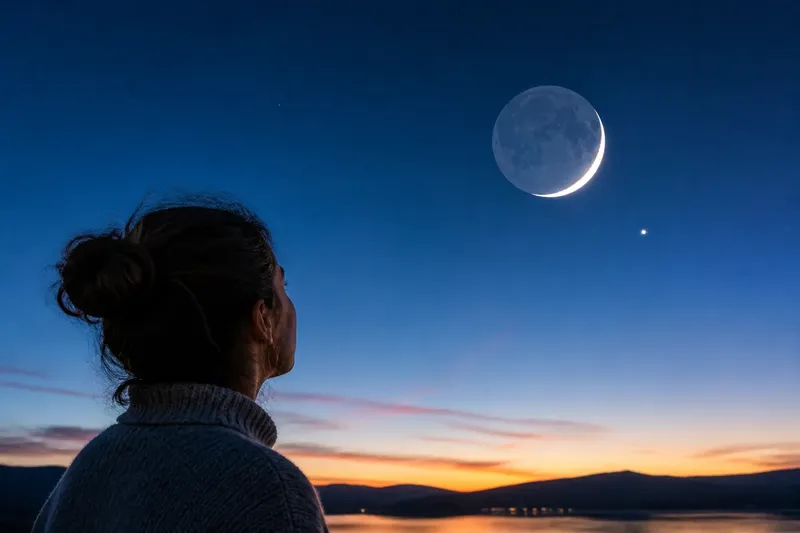
The Moon’s changing face is a matter of viewpoint: sunlight always illuminates half of the Moon, while the portion we can see from Earth shifts as the Moon travels around us. A crescent is not the Moon slipping into Earth’s shadow. It is a slender view of the Moon’s daytime side, with most of that lit half turned away from our line of sight.
That simple geometry explains the familiar sequence from new Moon to full Moon and back again. It also gives you a useful way to decide what you are looking at: match the Moon’s shape and position in the sky to where the Sun must be, rather than imagining a shadow crossing its surface.
What changes as the Moon travels around Earth?
The Moon circles Earth, and sunlight reaches it from a direction that changes relative to our viewpoint. At any moment, one hemisphere faces the Sun and is illuminated; the opposite hemisphere is dark. The boundary between them is called the terminator, although it is not a border painted onto the lunar surface. It marks where daylight fades into lunar night.
From Earth, we see a different fraction of the sunlit hemisphere as the Moon moves along its orbit. When the Moon is roughly in the direction of the Sun, its lit side faces mostly away from us. This is new Moon: the Moon may be in the sky, but its bright face is turned towards the Sun, so the unlit side is generally what faces Earth.
As the Moon moves away from that alignment, a thin bright crescent becomes visible. The illuminated portion appears to grow through first quarter and then towards full Moon, when the Moon is opposite the Sun in our sky and we face almost all of its sunlit hemisphere. It then appears to shrink through the waning phases before returning to new Moon.
The cycle takes a little longer than one orbit around Earth because Earth is also moving around the Sun. The Moon must travel a little farther after completing an orbit to return to the same arrangement relative to the Sun and Earth. That repeating arrangement produces the phase cycle.
Why is the Moon’s shape not an Earth shadow?
A lunar phase is the part of the Moon’s sunlit half that happens to face us. An Earth shadow is involved in a different event: a lunar eclipse. During an eclipse, Earth moves between the Sun and the Moon, and its shadow falls across the Moon. The alignment is relatively uncommon because the Moon’s orbital path is tilted compared with Earth’s path around the Sun.
That distinction is easy to check in the sky. Ordinary phases change gradually over the cycle, with the lit and dark portions separated by a curved boundary. During a lunar eclipse, Earth’s shadow advances across the full Moon over a limited interval, and the event does not account for crescents or quarters during the rest of the month.
The Moon’s own surface also helps explain the appearance. Craters, plains and mountains do not move around to make the phases. Sunlight falls across the same familiar features from changing angles; as the lit area we see grows or shrinks, different regions fall inside its bright portion.
Which phase fits the sky you are observing?
Choose the description that best matches your situation. Phase names describe how much of the visible lunar disc is illuminated; “waxing” means the lit portion is growing, and “waning” means it is shrinking.
- You see a thin crescent after sunset: It is likely a waxing crescent, with the Moon beginning its visible progression away from new Moon. The crescent’s sunlit edge points generally towards the Sun’s direction, even if the Sun has already dipped below the horizon.
- You see a half-lit Moon in the evening: It may be first quarter. The term names a position in the phase cycle, not a shape that looks like a quarter of a circle: from Earth, about half of the disc appears lit.
- You see a bright, nearly round Moon around sunset: It is likely near full Moon. A full Moon rises around sunset because it lies roughly opposite the Sun in the sky, though the exact timing varies with the Moon’s position.
- You see a thinning Moon before sunrise: It is likely waning, moving towards new Moon. A waning crescent often appears in the morning sky because its position is then on the Sun-facing side of the sky before the Sun rises.
- You cannot see the Moon at all: It may be near new Moon, but clouds, buildings, a low horizon or bright twilight can also hide it. Absence from view alone does not identify a phase.
These are useful clues, not a substitute for checking the Moon’s position. The viewing time shifts from phase to phase, and local horizons or weather can change what is visible. A sky map or a lunar calendar can help confirm the phase if the view is ambiguous.
Why does the crescent sometimes look faintly complete?
On some nights, the dark part of a thin crescent is faintly visible too. This is earthshine: sunlight reflected from Earth reaches the Moon’s night side and then reflects back towards us. It can make the rest of the disc appear as a dim outline, but it does not mean the Moon is lit from within or that Earth’s shadow is covering it.
Earthshine is easiest to notice when the crescent is slim and the sky is dark enough for the low-contrast glow to stand out. It can be hard to see through haze, bright twilight or urban skyglow. The bright crescent remains direct sunlight reflected from the Moon; the dim remainder has taken an extra reflection via Earth.
Imagine you step outside after sunset and spot a narrow crescent with a ghostly grey circle around it. If the bright arc is clear and the rest is only a subdued glow, earthshine is a sensible explanation; if a cloud crosses the view, the whole Moon may fade together. That difference gives you a simple observational clue without confusing reflected Earthlight with the geometry that sets the phase.
How did people work out the phases?
The changing lunar appearance is a pattern people can follow without instruments. Watching the Moon over successive nights reveals that its shape repeats in a regular sequence and that its position shifts in relation to the Sun. Those observations support the geometric explanation: the Moon is a lit body moving around Earth, not a disc that alternates between being illuminated and switched off.
Careful observation also separates a phase from an eclipse. A crescent can be seen with the bright part on one side and the dark part on the other, while a lunar eclipse begins with a full Moon and a shadow that visibly progresses over it. The two appearances call for different explanations because the alignments are different.
There is no need to wait for a telescope to follow the cycle. A clear view and a note of the date, approximate time, phase shape and direction in the sky are enough to trace its broad progression. It is not worth trying to infer the exact orbital position from one glance: clouds, buildings and the Moon’s changing rise time can make a single observation misleading.
What questions help identify a lunar phase?
Does a first-quarter Moon mean one quarter of it is lit?
No. First quarter means the Moon has completed roughly a quarter of its phase cycle since new Moon. Its visible disc appears about half illuminated because we are looking at the boundary between the side facing the Sun and the side facing away from it.
Why can I see the Moon during the day?
The Moon is often above the horizon during daylight, and its sunlit surface can be bright enough to stand out against the sky. Its visibility depends on its position, phase and the clarity of the air, not on whether the Sun has set.
Does the Moon rotate if the same face points towards Earth?
Yes. The Moon rotates once on its axis in about the same time it takes to orbit Earth, so much of the same hemisphere remains turned towards us. This synchronous rotation is separate from the phase cycle, which depends on how sunlight and our viewing direction line up.
Why does the crescent’s tilt change?
The Moon’s path across the sky and the local horizon change the way its bright edge appears to tilt. The illuminated edge still faces generally towards the Sun, but “up” and “sideways” depend on where and when you are looking from Earth.
How can you read the next phase from the Moon?
Start with the illuminated fraction, then ask whether it is growing or shrinking compared with the previous sighting. A growing crescent is waxing; a shrinking gibbous Moon is waning. The change is gradual, so observations on separate evenings are more informative than trying to name a phase from a quick look alone.
Next, compare the Moon’s position with the Sun’s. A waxing crescent is generally found in the evening sky after sunset, while a waning crescent is commonly visible before sunrise. A quarter Moon is roughly a right angle from the Sun in the sky, and a full Moon lies broadly opposite it. These relationships follow from the geometry, though the Moon’s path and your local horizon affect the view.
The Moon’s changing face is therefore a moving view of a steady arrangement: sunlight illuminates half the lunar globe, and the Moon’s orbit changes how much of that bright half Earth can see. If you remember that the phase is a viewing angle rather than an Earth shadow, the shapes become easier to identify—and the faint glow of earthshine becomes a separate, equally satisfying clue about light travelling between worlds.