A Window-Sill Shadow Diary for One Afternoon
A window-sill shadow diary helps you track a shifting patch of light with consistent marks, useful notes and a clear line between what you see and why.
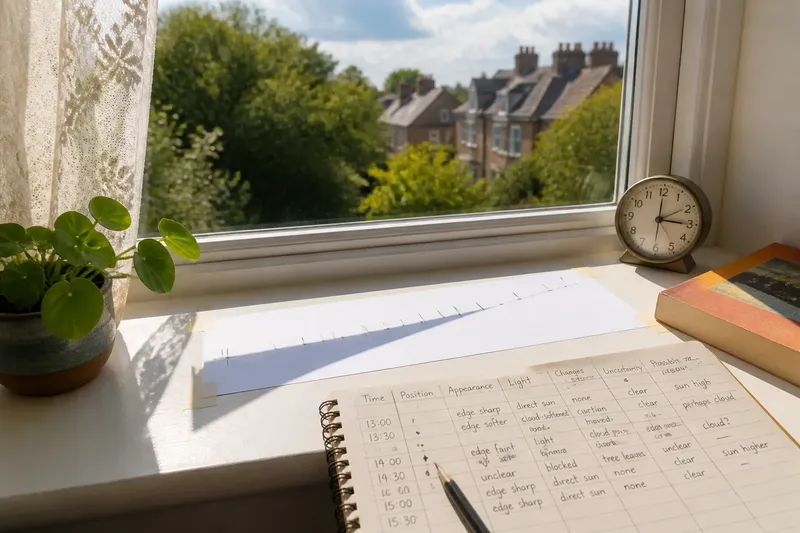
A window-sill shadow diary is easiest to read when the shadow has a clear edge and you mark it from the same viewpoint each time. But an afternoon of watching can still go sideways: the sun slips behind cloud, a curtain moves, or your notes quietly turn guesses into facts. A few small adjustments make the record more useful without turning a calm observation into a complicated experiment.
Choose one patch of shadow on the sill or nearby wall, and stay with it for the afternoon. You are tracking what changes, not trying to prove what caused it. That distinction is the diary’s main job.
Why is the shadow edge hard to mark?
A soft edge does not have one obvious boundary. Light can fade gradually across the sill, particularly when the sun is filtered through thin cloud or a translucent curtain. Tracing the darkest part at one visit and the faint outer edge at the next makes the shadow appear to jump.
Choose a rule before making the first mark. For a fuzzy boundary, you might follow the point where the surface first looks noticeably darker than the surrounding area. Keep using that same visual rule, even if the edge becomes less distinct.
Use a removable marker on a paper strip placed beside the shadow, rather than drawing on a painted sill. If the paper could move, secure its corners with low-tack tape and leave it in place. Mark one or two points on the same edge each visit; a short line between them is often clearer than an attempt to trace the whole shape.
If the shadow has no dependable edge, switch to a recognisable feature such as the tip of a narrow shadow cast by a plant stem. Note that you changed what you followed. Do not combine marks from two different rules as though they were one continuous track.
What if the shadow seems to jump between visits?
First check the scene, not the sky’s apparent motion. A chair, blind cord, leaf or your own arm may have crossed the light. A small shift in the paper or your viewing position can also make a stable edge seem to land somewhere new.
Keep your observation spot fixed. Sit or stand at the same side of the window, and look down from a similar angle. Mark the paper’s position against a sill corner or another fixed feature so you can notice if it has slipped.
Say you begin with a narrow shadow crossing the corner of a paperback. At the next look, it appears to have moved backwards. You notice the paperback was nudged when you opened the window, so you record “book moved” beside that mark rather than forcing the new position into the old track. The diary still contains a useful observation, with its interruption visible.
If the shadow is genuinely separated by a period you did not observe, leave a gap in the record. Do not draw a connecting line that suggests you saw its path. A gap is more informative than a neat but invented sequence.
How can you tell a sun change from a cloud change?
Cloud can dim a shadow or blur its boundary without changing the direction from which direct sunlight arrives. A shadow may become faint, then sharpen again as the cloud passes. That change in contrast is worth recording, but it is not by itself evidence that the shadow’s position shifted.
At each visit, note whether the light looks direct, softened or blocked. Use plain descriptions such as “edge sharp”, “edge faint” or “sunlit patch dim”. If you cannot tell whether a cloud caused the change, write “light dimmer; cause unclear”. That is a complete observation, not a failed explanation.
Compare the shadow’s position with the fixed marks, not only with how dark it looks. If cloud hides the edge, leave that visit unmarked or add a note that the boundary was unclear. When it reappears, resume using the same reference points.
What should each diary entry include?
Consistency matters more than elaborate equipment. A sheet of paper, pencil, removable tape and a clock are enough. Keep the page beside the window but out of the light path, and make each entry in the same compact format.
- Time: Record the clock time, using the same clock throughout.
- Position: Mark the shadow’s chosen edge against the paper or fixed sill reference.
- Appearance: Note whether the edge is sharp, soft, faint or partly hidden.
- Light: Describe direct sun, cloud-softened light or a blocked view.
- Changes nearby: Record any movement of the curtain, object, paper or window.
- Uncertainty: Mark unclear views as unclear instead of filling in a likely position.
Leave a little space beside each mark for observations. Keep explanations separate, perhaps in a second column headed “possible reason”. This simple layout prevents a note such as “shadow moved because the sun shifted” from being mistaken for something directly seen.
Which questions help separate seeing from explaining?
What counts as an observation?
An observation describes what you could see or note directly: “the dark edge is beside the tape mark” or “the patch is faint”. It does not name a cause. You can check it against the page or the scene.
How should I record a possible cause?
Put a possible cause in a separate note and use tentative wording, such as “perhaps a cloud softened the light”. If you did not see the cloud move across the sun, do not write that it definitely caused the change.
What if I miss a visit?
Record the time you returned and leave the gap visible. A missed observation cannot be recovered from the positions before and after it, even if a smooth path seems likely.
Can I compare the shadow with an outdoor object?
You can, but treat the comparison as another observation, not a calibration. A tree or fence may offer a useful visual reference, yet it can also be partly hidden or viewed from a different angle.
When does the window itself complicate the record?
Glass, curtains and room surfaces can alter what reaches the sill. Reflections may add a bright patch; a net curtain may soften an edge; a deep frame can hide low-angle light. These features are part of the scene, not nuisances you need to remove.
Note any change in the window setup, and avoid moving blinds or curtains mid-session unless you intend to record that change. If condensation, reflections or an insect on the glass makes the boundary hard to see, describe the obstruction and pause the position marks until the feature is clear again.
Do not spend the afternoon trying to make every condition perfectly controlled. That effort is rarely useful for a low-stakes diary: the aim is a readable record of one real window, not a laboratory arrangement. A brief note about a moving curtain tells you more than an elaborate attempt to eliminate every influence.
What can the finished page tell you?
Lay the entries in time order and look for changes you actually recorded: the edge’s position, its sharpness and any interruptions. You may see a steady drift, a stretch of obscured light or a sequence too patchy to interpret. Each is a fair description of the afternoon’s record.
A line joining marks can help the eye, but draw it lightly and only between observations that use the same reference and boundary rule. It represents a visual guide, not a path you watched continuously. If the marks do not line up neatly, keep them as points rather than smoothing them into a persuasive curve.
A window-sill shadow diary works best when its limits remain visible. The page can show where a shadow was seen and what conditions accompanied it; it cannot, on its own, settle every cause behind a change. Keep the marks consistent, keep explanations tentative, and let an honest blank space remain blank.